
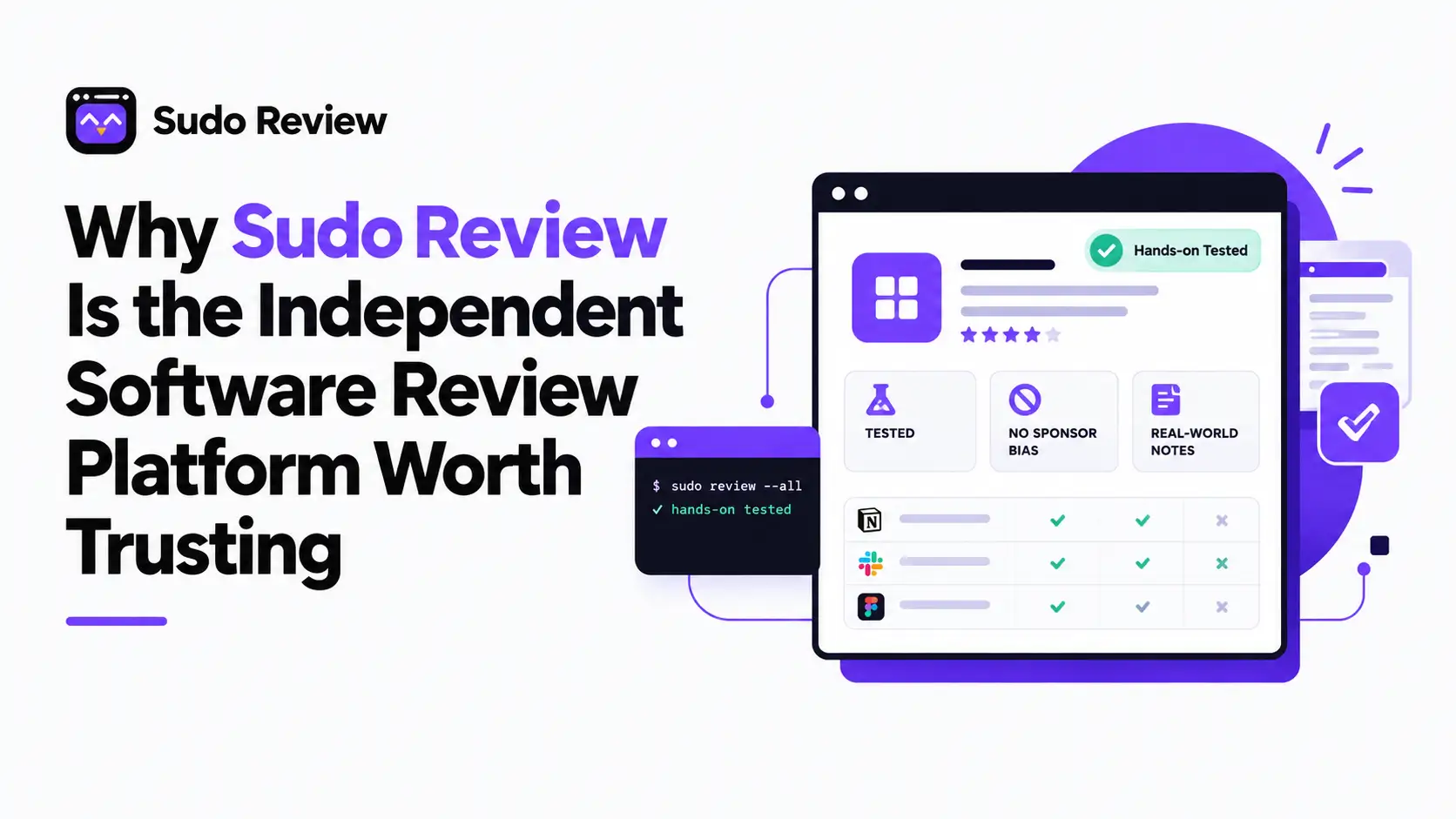
That sentence is the whole pitch. The rest of this article shows why it holds up.
Most people searching for software reviews hit the same wall. Page one fills up with listicles built to win a click, not to help you decide. Many are sponsored. Many are rewritten from a press release. Few tell you what it costs to live with a tool for a month. If you want independent software reviews, unbiased software reviews, or simply honest software reviews you can act on, the first question is always who paid for the opinion.
Sudo Review answers that question on its homepage: every tool is used on a real project before it is reviewed, the site shows zero sponsors, and the verdict is not for sale. Below are five reasons that matters, from what the site covers to why it is a good place to put your own project in front of developers. Think of it as a software buying guide for the reviewer itself.
1. A review platform built for anything tech
Sudo Review works as an independent review platform for software, SaaS, apps and open-source projects because it tests every one of them the same way. The method does not care whether a tool is a paid SaaS product, a free web app or a self-hosted project you run on your own server.
The tools named on the homepage show the range:
–
Developer tools: Cursor, Warp, Supabase, Astro, Vercel, Netlify and Render, plus Copilot for AI-assisted coding.
–
Productivity apps: Notion for notes and knowledge, Linear for task and project tracking, Raycast for day-to-day speed.
–
Open source and self-hosted: Immich, a self-hosted photo library often used as a Google alternative.
–
Publishing platforms: WordPress, with its own CMS and plugin roundups.
That spread matters if you want software reviews and comparisons rather than one-off opinions. Because each tool goes through the same project setup, the same daily use and the same scoring, you can put two tools side by side and trust the comparison. The Vercel vs Netlify vs Render roundup is the clearest example: three hosts tested on the same Astro app, measured on pricing, cold starts and developer experience. That is a real software comparison, not a feature-table copy-paste.
It also reads as a source for software alternatives. When a tool earns a verdict that includes its limits and its price, the next question is what else does the job. A site that logs cost and bugs as it goes is well placed to answer that, whether you are after free software alternatives, open source alternatives or a cheaper paid option.
Software is the core of the catalog today. Nothing in the method depends on the product being code, though. A project-first test, benchmarks and a cost log fit hardware and IT gear just as well, so the same standard can follow readers from the apps they use to the devices they run on.
2. Why it earns more trust than sponsored media
Sudo Review earns trust the only way a review site can: by making its incentives easy to check. No site can prove it is trustworthy in a paragraph. What it can do is remove the money that bends opinions and publish the rules it follows instead.
Sponsored media runs on a different model. When a brand pays for placement, supplies a review unit or funds the channel, the reviewer has a reason to stay polite. Even a well-meaning writer feels that pull. Sudo Review cuts it at the source.
|
Question |
Typical sponsored review |
Sudo Review |
|---|---|---|
|
Who pays for coverage? |
Often the brand being covered |
Nobody. Zero sponsors, no paid placements |
|
Does the reviewer get free access? |
Often a review copy or demo account |
No review copies. Tools run on the plan a normal customer would pick |
|
Is the review based on a demo? |
Frequently |
Never. Every tool is set up on a real project |
|
Can a company buy a better verdict? |
Rarely stated |
No. “Nobody can pay for a verdict” |
|
What happens with affiliate links? |
Often undisclosed or unclear |
Disclosed on the page. They never change a ranking |
The affiliate point deserves a closer look, because it is where many sites quietly lose independence. Sudo Review says some links earn a commission and that this never changes a ranking or a verdict. Tools without an affiliate program are ranked by the same rules. That is the standard to hold any review site to.
This also makes the site useful for software pros and cons that stay honest about the cons. A reviewer with nothing to protect can say a tool is slow, overpriced or not worth switching to. For anyone weighing free vs paid software, or asking which software is worth paying for, that candor is the product.
The audience signal points the same way: more than 5K subscribers follow the YouTube channel. That is not proof of trust on its own. Alongside a no-sponsor policy and a published method, it suggests people are choosing the format on purpose.
3. Easy for beginners, reliable for professionals
Sudo Review is easy to follow for non-technical readers and still rigorous enough for working developers because both groups get the same three things: one score, one verdict and the evidence behind it.
Every review is built on a single formula, published on the homepage:
score(tool) = 0.3 × Speed + 0.4 × Developer experience + 0.3 × Value
The Sudo Review scoring formula
A beginner does not need to know what a cold start is to read that. They see one number, built from how fast the tool is, how pleasant it is to use and whether it is worth the money. That makes it a practical entry point for anyone reading software reviews for beginners, or choosing the best apps for everyday use without wanting a spec sheet.
The format helps too. Each tool gets a full video and a written review, so you can watch the tool in use or skim the text, whichever suits you. The plain question behind each one is the one everyone asks: does it work, what does it cost, and where does it break?
Professionals get the depth underneath. The process is four steps:
1
Project setup: a real-world scenario, used the way a real user would use it.
2
Daily use: long enough to hit the limits, the bugs and the pricing surprises.
3
Benchmark and log: speed tests, bug notes and cost tracking feed the score directly.
4
Publish the verdict: video and written review, with the method behind both.
The weights say who the site is built for. Developer experience carries 40% of the score, more than speed or value alone. That suits software for developers, software for power users and anyone judging tools for remote work, where daily friction adds up. It also rewards lightweight, minimal software that gets out of the way, and cross-platform apps that fit more than one setup.
The method guide publishes the full rubric, so a professional can check how a number was reached instead of taking it on faith. That is the difference between a hands-on review and an opinion.
4. Why it is reputable
Sudo Review is reputable because its reputation rests on behavior you can verify, not on claims. A reputable review brand does the same slow, unglamorous work every time, and says so in public.
|
Signal |
What the site states |
|---|---|
|
Real-project testing |
23 tools tested inside real projects |
|
Minimum test time |
At least four weeks in a real project before scoring |
|
Sponsorship |
0 sponsors; no sponsorships, paid placements or review copies |
|
Transparent scoring |
Weighted formula, with the full rubric in the method guide |
|
Price accuracy |
Prices on every deal and roundup rechecked weekly |
|
Affiliate honesty |
Commission links disclosed; rankings unchanged by them |
|
Audience |
5K+ YouTube subscribers |
The four-week minimum is the detail that separates software testing and reviews from a launch-day impression. Pricing surprises, rate limits and rough edges rarely show up in the first hour. They show up in week three, which is why the process is built to reach it.
The weekly price check matters just as much for anyone doing a software pricing comparison. Plans change, discounts expire and free tiers shrink. Roundups the site would “send to a friend” only work if the numbers are current, and the site commits to rechecking them every week.
Consistency is the last piece. The site applies the same process to every tool, so a verdict on a well-known product and a verdict on a lesser-known one come from the same standard. That is what makes technology product reviews comparable over time, and why the tools it covers read as tech tools worth using rather than a sponsor roster.
5. A place to share your next big project
Sudo Review is a strong place to put your project in front of developers because it offers the one thing paid promotion cannot: a hearing from an audience that knows nobody was paid to be kind. The trade is honesty. You cannot buy a review, and you cannot buy a good one.
That is exactly the appeal for makers with a product they believe in. If you build open source software, a small SaaS, a free web app or a lesser-known app, a verdict from a site with zero sponsors carries weight that an advertisement never will. Praise from a reviewer who also writes critical reviews is worth more than praise from one who never does.
The homepage also gives readers a direct way in: a request form where visitors tell the site which tool to cover. The site says it will add the tool to the queue. Being queued is not a promise of a review, and it is never a promise of a positive one.
To make your project easy to test fairly:
1
Submit it through the request form. Send the tool name and what it does.
2
Make the normal plan easy to use. Reviews run on the plan a typical customer would pick, so a clear free tier, trial or self-hostable build helps.
3
Document the real use case. The test starts from a real-world scenario, so a clear setup guide saves everyone time.
4
Expect weeks, not minutes. The process includes at least four weeks of use before a score is published.
5
Plan for the full picture. The review covers where the tool works, where it breaks and what it costs.
This suits underrated software especially well. Open source maintainers, indie founders and creators building useful software tools rarely have an advertising budget. An independent review is one of the few routes to developers who actively look for software recommendations before they commit. Even a critical verdict hands you specific, tested feedback on speed, developer experience and value, which is worth having before your next release.
Where to start if you are hunting for alternatives
The fastest way to use Sudo Review is to start with the problem you want solved, then read how the tools that solve it held up. Here is how that works for the searches people run most.
–
Free and open source. For free software tools and the best free software, start with the roundups. 5 Best Free CMS Tools compares headless and traditional options the team has shipped real client sites with. Open source alternatives to paid products are where independent testing matters most, because a free price tag hides setup cost and maintenance.
–
Self-hosted and privacy-focused. Self-hosted software is a good fit for people who want control over their data. Immich is the example on the homepage: a self-hosted option for those looking for Google alternatives. When you weigh the best self-hosted apps, ask what hosting costs in time, not only money. Privacy focused software and privacy friendly apps deserve the same test as everything else.
–
Productivity and AI. For the best productivity software and best productivity apps, look at how Notion, Linear and Raycast scored on daily use rather than feature lists. The same goes for the best AI tools and best AI productivity tools: Cursor and Copilot are tested as AI coding tools on real projects, which is the only setting where their value shows. Task management software, note taking apps, project management tools and time management apps all benefit from weeks of real use.
–
Developer tools. For the best developer tools and best developer productivity tools, the hosting comparison and the tools named above give you a tested starting point, from terminals and editors to backends and deployment.
–
Deals. WordPress Plugins on Sale lists plugins worth paying for at the lowest prices the site has tracked this year, with discounts up to 60%. Software deals only help when the tool is good, which is why every pick is tested first.
Use these as filters, not as final answers. The best software alternatives are the ones that fit your workflow, your budget and your tolerance for setup, and a score only helps if you can see how it was earned.
The verdict
Sudo Review is worth your time for a simple reason: it gives you the context other sites sell. Real projects, weeks of use, a published formula, disclosed affiliate links and zero sponsors add up to a review source you can check rather than just believe. Readers get honest software reviews they can understand. Developers get depth they can audit. Makers get a fair test.
Start at sudoreview.dev, watch a review on the YouTube channel, or tell the team which tool to cover next. If the tool is worth using, that process will say so. If it is not, it will say that too.

Written by
Mashfiquar Rahman
Founder and lead reviewer
Mashfiquar collects open-source projects the way other people collect mugs. He will happily lose a weekend to a new self-hosted tool, reads changelogs for fun, and founded Sudo Review to share the ones that survive real use.
On this page
07
$ sudo
request –tool